Showing posts with label Cutting Edge. Show all posts

Sunday, 1 May 2016

Cutting Edge: The Blair Witch Project

Often horror films play with the viewers imagination, convincing them that some monster, beast, supernatural force, or psychopath is out to get the characters. However, Daniel Myrick and Eduardo Sánchez's found footage horror film, 'The Blair Witch Project' (1999), plays with the imagination in a very different way. Unlike some horror films, The Blair Witch Project purposefully avoids showing the viewer what is terrorizing the characters. On top of that, it convincingly feels like found footage, as though the viewer is watching these events happen to real people. Myrick and Sánchez play with primal instinct and basic human fears to scare the audience.

Fig 1. 'The Blair Witch Project' (1999)

By forcing the actors into similar positions as their characters, the film seem real despite the viewer knowing it's not. Most people can relate to the fear and panic of being lost or how lack of sleep or food can inhibit clear, rational thinking. Since the actors themselves were put into these conditions, their improvised lines feel even more real."Though the story was plotted very carefully, the dialogue was improvised. The raw, amateurish-seeming scenes that result... only pull us deeper into the film's illusion of what we're seeing really happened. The actors, who actually spent several days in the woods, eating less and less and never quite sure of what was going on, come apart harrowingly," (Rose, 1999). Seeing how fast people succumb to stress and turn on each other is frightening in itself.

The Blair Witch is known for causing motion sickness for the viewer due to the fact that one of the cameras (the one used most in the film) is handheld. Because of this, it is often hard to see what is going on and many of the scenes are focused on monotonous leaves, trees, and dirt as the characters wander in the woods. While this use of camera can cause motion sickness, it also increases the tension by forcing the audience to have a limited view of what is going on."The cameras, which can't capture the thing or things that go bump in the night, produce increasingly shaky images that reflect the nerves of the crew," (Travers, 1999).

However, there are portions of the film where we can see the characters and environments clearly. Glimpses of children's handprints on walls, hanging stick figures, and creepy abandoned houses give the viewer enough information to piece together that something bad is after the characters. Even just seeing Heather's panicked, tearful eyes as she apologizes to her camera for endangering Mike and Josh is more than enough to transfer her fear into the viewer. The camera wavers, Heather hyperventilates and cries, and makes a very real and relatable statement that she is "too afraid to close her eyes and too afraid to open them".

Fig 2. Heather
The Blair Witch has received much attention and praise despite it being such a low budget film. By making the film feel as thought it was a real documentary that was found, it plays on the primal instincts and fears of the viewers. Instead of investing in special effects, the real horror comes from the reactions of the characters, the authenticity of the locals they interview, the shakiness of the cameras, and the unknown entity that hunts them. "At a time when digital techniques can show us almost anything, 'The Blair Witch Project' is a reminder that what really scares us is the stuff we can't see. The noise in the dark is almost always scarier than what makes the noise in the dark, " (Ebert, 1999). Not knowing what is actually after the characters and often not being able to see what is going on makes the film even more unsettling.

Fig 3. Running
Despite how real this film feels, depending on the viewer, some parts can seem somewhat ridiculous. For example, one would think that after hearing the screams of Josh, knowing the stories of a hermit who murdered children in a house in the woods, and discovering a pile of sticks with bloodied rags, that your instincts would say 'do not go into that abandoned house'. To some, it may also seem silly that Heather would record their whole predicament despite its seriousness. However, considering how many people are addicted to social media today, it feels like something many people would do. Perhaps this film should make people reflect on this strange desire to document oneself obsessively, is it really worth putting yourself and others at risk?

The Blair Witch Project is evidence that even with a low budget and an idea, a great and inventive film can be made. While it may not be filmed using the best cameras or high end special effects, it grabs the audience's attention and makes them feel the stress and anxiety the characters feel. This film is all about the imagination, it's the viewer's imagination that creates the monster, the beast, supernatural force or psychopath. Some people may think it was the witch who got them, or maybe a ghost, the hermit or possibly even Josh just pulling a prank. The Blair Witch Project plays on realistic, everyday human fears such as the fear of the unknown and the fear of getting lost to engage and immerse the audience. By utilizing the stress of the characters to heighten the feeling of dread, the film creates a very realistic and relatable situation that is unsettling to watch, even if it is all fake.

Bibliography:
Ebert, R. (1999) The Blair Witch Project At: http://www.rogerebert.com/reviews/the-blair-witch-project-1999 Accessed on: 1/5/2016
Maslin, J (1999) Film Review; Vanished in the woods, Where Panic Meets Imagination At: http://www.nytimes.com/movie/review?res=9C02E6D91E3CF937A25754C0A96F958260 Accessed on: 1/5/2016
Rose, L. (1999) Documentary Style Aids 'Blair Witch' At: http://www.washingtonpost.com/wp-srv/style/longterm/movies/videos/blairwitchprojectrose.htm Accessed on: 1/5/2016
Thomas, W. (2000) The Blair Witch Project Review At: http://www.empireonline.com/movies/blair-witch-project/review/ Accessed on: 1/5/2016
Travers, P. (1999) The Blair Witch Project At: http://www.rollingstone.com/movies/reviews/the-blair-witch-project-19990730 Accessed on: 1/5/2016

Illustration List:
Figure 1. The Blair Witch Project [Poster] At: http://hiddenhorizons.net/wp-content/uploads/2015/03/blair_witch_project-poster.jpg Accessed on: 1/5/2016
Figure 2. Heather [Film Still] At: http://images.mentalfloss.com/sites/default/files/styles/article_640x430/public/blair_large.jpg Accessed on: 1/5/2016
Figure 3. Running [Film Still] At: http://www.thenightmarenetwork.net/wp-content/uploads/2015/10/blairwitch2.png Accessed on: 1/5/2016

Tuesday, 12 April 2016

Cutting Edge: The Sixth Sense

Often films under the horror genre aim to scare and horrify the audience. However, that was not the main goal of M. Night Shyamalan's paranormal/psychological horror-thriller film 'The Sixth Sense' (1999). While this film does have eerie scenes and a few jump-scares, it is the development of the characters and the dialogue between them that really stand out. The Sixth Sense, like many horror films, has a twist ending that completely blindsides the audience. While this plot twist is more tear jerkingly emotional than scary, it ties off the loose ends of the story perfectly.

Fig 1. The Sixth Sense (1999)
It's very unusual to find a horror film that can combine such heartfelt characters and both psychological and paranormal horror with a ending that is both sad and somewhat comforting, "...this is an entrancing film, which dabbles in profound character revelation and the paranormal - something you don't often see in a movie," (Howe, 1999). However, Shyamalan's ability to build up tension and atmosphere allows for this strange combination. The Sixth Sense does not go for extremes like most horror films do. There isn't an immense amount of gore, excluding a few wounds on the ghosts, and the jump-scares aren't too intense.

Perhaps this lack of extremes is what allows the film to be scary and touching at the same time, "...subtlety is the key throughout, not big ding-dong stingers but evocative trails and hints of the truth...Shyamalan's direction is the model of restraint - disquiet and stillness pervade while he expertly utilizes sound to enhance the discomforting feeling that something indefinable being present (allowing the audience its own 'sixth sense')," (Nathan, 2000). Through subtle cues, the audience can pick up when something is wrong without the face of a rotten corpse popping onto screen or a sudden screeching sound effect deafening the audience.

Fig 2. Misty Breath
Instead, we see the terrified expression of Cole (Haley Joel Osment). When a ghost is present, we see him go rigid, his breath appears misty as the temperature drops, eerie music score creeps in. Even without seeing what he sees, the viewer can relate to Cole's fear which is largely due to Osment's superb acting. Usually child actors are not particularly striking in films, but given a child's lack of experience due to their age it is understandable. Arguably, young children are not lead roles in live-action films because of this lack of experience. However, this is not the case with Osment and his character Cole. "Haley Joel Osment is a very good actor in a film where his character possibly has more lines than anyone else. He's in most of the scenes, and he has to act in them--this isn't a role for a cute kid who can stand there and look solemn in reaction shots. There are fairly involved dialogue passages between Willis and Osment that require good timing, reactions, and the ability to listen...those scenes give the movie its weight," (Ebert, 1999).

Osment's acting gives Cole a maturity that signals to the audience that he's been through things that most people haven't. This adult-ness and ability to communicate with adults in a way that is interesting for the audience encourages us to connect to his character and Malcolm (Bruce Willis). Both actors perform in a way that allows them to have meaningful dialogue without the child sounding ignorant or the adult appearing to be condescending towards the child. Cole and Malcolm (and the actors playing them) are equals throughout the film.

Fig. 3 Cole and Malcolm
This relationship makes both the characters and the story more sincere and heartfelt, reeling in the audience for the big surprise at the end. The Sixth Sense is a strange film in that some scenes confirm it is a horror film, but other parts  of the movie feel very different. There are a few scenes where there is gore or disturbing imagery but those scenes are built up in a way that it doesn't feel as sudden and jumpy as most horror films would have it. It is refreshing to see a film that can be chilling and moving at the same time.

After watching, it is hard to put it under the 'horror' category completely because Cole and Malcolm's relationship and the twist ending shows there is so much more to it. Shyamalan managed to achieve a deep, heartfelt story while integrating subtle horror cues that will make the hairs on the back of your neck stand up. Looking back after watching the ending, its easy to see all the hints which leaves the viewer wondering, 'How did I not see that coming? I have to watch it again.'

Bibliograhy:
Ebert, R. (1999) The Sixth Sense At: http://www.rogerebert.com/reviews/the-sixth-sense-1999 Accessed on: 12/4/2016
Holden, S. (1999) Film Review; A Boy Who Sees the Dead, and a Psychologist Determined Not to Fail Him At: http://www.nytimes.com/movie/review?res=9802E3DB1430F935A3575BC0A96F958260 Accessed on: 12/4/2016
Howe, D. (1999) A Chillingly Intense 'Sense' At: http://www.washingtonpost.com/wp-srv/style/movies/reviews/sixthsensehowe.htm Accessed on: 12/4/2016
Nathan, I. (2000) Empire Essay: The Sixth Sense Review At: http://www.empireonline.com/movies/empire-essay-sixth-sense/review/ Accessed on: 12/4/2016

Illustration List:
Figure 1. The Sixth Sense [Poster] At: http://img.goldposter.com/2015/04/The-Sixth-Sense_poster_goldposter_com_14.jpg Accessed on: 12/4/2016
Figure 2. Misty Breath [Film Still] At: http://images.myreviewer.co.uk/fullsize/0000222764.jpg Accessed on: 12/4/2016
Figure 3. Cole and Malcolm [Film Still] At: http://www.themoviedistrict.com/wp-content/uploads/2014/01/thesixthsense06B.jpg Accessed on: 12/4/2016

Tuesday, 5 April 2016

Cutting Edge: The Wicker Man

Despite now being considered a cult classic, Robin Hardy's 'The Wicker Man' (1973) didn't seem to attract the attention it deserved immediately after its initial release. Years passed before the film became known as a great horror film, even being considered one of the greatest within the 'folk horror' subgenre. The Wicker Man has endured time, which could be due to renewed interest when new footage is discovered and restored. Against all odds, The Wicker Man remained successful "...the film's reputation even survived Neil Labute's disastrous 2006 U.S. remake, starring Nicolas Cage...which was fatally low on tension and bombed at the box office," (Dalton, 2013).

Fig 1. 'The Wicker Man' (1973)
Part of this success is due to Anthony Shaffer's screenplay, which is undoubtably more impressive than the 2006 remake. In fact, it is probably the most recognized elements of The Wicker Man, "the film's opening titles read 'Anthony Shaffer's The Wicker Man' in one of the rare instances where the screenwriter is given ownership of a film over its director," (Calhoun, 2013). Because of the script, the viewer is easily immersed within the world. Little hints are dropped within the dialogue, sets, camera shots, and song lyrics (Composed by Paul Giovanni and Magnet) to give the audience the feeling that there is something odd about Summerisle. Despite this suspicion and possibly knowing the ending from watching the remake, the ending is still a shock.

Even if viewers already know what is going to happen, The Wicker Man expertly manipulates the audience to feel uneasy. It is the final act of the film that is truly horrifying when the intentions of the villagers are revealed. Our protagonist Sergeant Howie (Edward Woodward), a Christian police officer, is burned alive (alongside several animals) as a sacrifice to appease the Pagan gods so the island's crops don't fail as they did the previous year. It is disturbing to think that some small talk about the lack of apples Howie had earlier with Willow (Britt Ekland) is actually the cause of his horrific demise.

Fig 2. Summerisle Apples
At first it is difficult to pinpoint what 'type' of film The Wicker Man is set out to be, but by the time the film reaches the final act it becomes clear it isn't as light hearted as it first appears to be. Everyone on the island appears to be 'normal' until we see casual public nudity/sex, young girls in school learning about phallic symbols (as the boys outside dance around it), naked women dancing around fires, a mother treating her daughter's illness by putting a frog into her mouth, people wearing animal masks and strange human-shaped cakes and breads.

On top of that, the merry sounding folk songs that are sung throughout the film end up being anything but innocent and cheerful. "The movie also excels in the fact that several elements of the picture could have been laughable but instead helped to add to the nauseating and uncomfortable atmosphere of the film...these musical interludes performed by different characters actually help to immerse the senses into the world of this strange little island, helping to create a suffocating and intoxicating atmosphere," (Doyle, 2015). The lyrics of the songs give hints to the true nature of the island.

Fig 3. Women Dancing and Singing
Even if the viewer had watched the 2006 remake, the original still demands attention. It is a real shame that some of the footage remains lost, but even with parts missing it is still immersive and (mostly) coherent. This coherence is sometimes interrupted due to how abstract and unusual the rituals/habits of the villagers are. Perhaps this is also due to how there are currently less people who believe in religion as strongly as people did in the 1970's. Occasionally there are holes in the plot or flaws in storytelling, causing the viewer to miss an important piece of information. One example is how the viewer doesn't learn that Howie is a virgin until later in the film through dialogue with Lord Summerisle (Christopher Lee). For a man of his age, and considering he is apparently engaged, it may not usually be assumed that Howie is a virgin (in fact, his virginity may not be thought about at all). This vital information may be lost if the conversation was misheard or if the viewer was distracted.

The Wicker Man leaves the viewer guessing even after the credits roll. The film concludes with our protagonist being burned to death in The Wicker Man, "a resolutely downbeat finale that's as far removed from a happy ending as it's possible to get...it's a movie that'll burn its way into your unconscious and give you nightmares for many years to come," (Russell, 2001). Now the viewer is left guessing: Do the police come looking for him? Do the villagers get caught and punished? Do their crops return? If not, is Lord Summerisle sacrificed or does he manipulate his way out? Unfortunately, no one will ever know.

Bibliography:
Calhoun, B. (2013) "The Wicker Man": The Cut May Be Final, But The Film Is Still Incomplete At: http://www.rogerebert.com/balder-and-dash/the-wicker-man-the-cut-may-be-final-but-the-film-is-still-incomplete Accessed on: 5/4/2016
Dalton, S. (2013) The Wicker Man: The Final Cut: Film Review At: http://www.hollywoodreporter.com/review/wicker-man-final-cut-film-635790 Accessed on: 5/4/2016
Doyle, K. (2015) In Memory of Christopher Lee - An Analysis of The Wicker Man (1973) At: http://www.thefilmagazine.com/in-memory-of-christopher-lee-an-analysis-of-the-wicker-man-1973/ Accessed on: 5/4/2016
Russell, J. (2001) The Wicker Man (1973)  At: http://www.bbc.co.uk/films/2001/12/17/the_wicker_man_1973_review.shtml Accessed on: 5/4/2016

Illustration List:
Figure 1. The Wicker Man [Poster] At: http://crypticrock.com/wp-content/uploads/2015/06/wicker_man_poster_01.jpg Accessed on: 5/4/2016
Figure 2. Summerisle Apples [Film Still] At: http://screenmusings.org/movie/dvd/The-Wicker-Man/pages/The-Wicker-Man-449.htm Accessed on: 5/4/2016
Figure 3. Women Dancing and Singing [Film Still] At: http://screenmusings.org/movie/dvd/The-Wicker-Man/images/The-Wicker-Man-254.jpg Accessed on: 5/4/2016

Tuesday, 15 March 2016

Cutting Edge: Rosemary's Baby

Often in horror films, suspense is key to engaging the audience. In Roman Polanski's 'Rosemary's Baby' (1968) a very different technique is used to achieve a feeling of dread and horror. Adapted from Ira Levin's novel, this film does not suddenly shock the audience, something is common with films in this genre. In fact, one might not even believe it was 'horror' to begin with. However, as the film progresses it becomes clear that there is something much more sinister lurking under the surface.

Fig. 1 'Rosemary's Baby' (1968)
The film starts off rather innocently, a young woman named Rosemary (Mia Farrow) and her husband Guy (John Cassavetes) move into a new apartment. They eventually befriend their older neighbors Minnie (Ruth Gordon) and Roman (Sidney Blackmer) who can be quite nosey but appear to be harmless enough. While Rosemary wishes to have a baby, her husband Guy seems more interested in his acting career than starting a family. However, they eventually decide to have a child, which is where the film begins to take a dark and unexpected turn.

Watching 'Rosemary's Baby' is an interesting experience as the audience knows something odd is going on relatively early in the film. This is very unusual for a horror film as usually the viewer is kept in the dark so a surprise can be delivered at the end. Instead, Polanski "gives the audience a great deal of information early in the story, and by the time the movie's halfway over we're pretty sure what's going on in that apartment next door. When the conclusion comes, it works not because it is a surprise but because it is horrifyingly inevitable," (Ebert, 1968). Early in the film Rosemary, clearly drugged, is seemingly raped by some monstrous creature in a surreal and disturbing dream. Although Rosemary dismisses this dream as her husband Guy having sex with her while she was unconscious, the viewer is left to suspect that this is not the truth.

Fig. 2 The Devil's Eyes
The viewer is then forced to witness Rosemary slowly suffer through her pregnancy and she begins to piece together what is really going on in her apartment building. This feels frustrating and difficult to watch at times due to how innocent and naive the character is. If everything about witchcraft and satanism is true it is clear that she would be incapable to fight against it. "Polanski slyly exploits her mannered childishness. Even before she gets pregnant she wears shapeless little smocks and flat, little girl shoes...Rosemary repeats parrot-fashion other characters' statements and allows herself to be completely dominated,"  (Errigo, 2000). It is clear that even though Rosemary cares about her baby's safety, she has a certain weakness to her that allows people to take advantage of her.

Fig. 3 Rosemary's Dress
This is also clear by her reaction to her husband after her dream where she was raped by a demonic monster. When she wakes up, she discovers scratches on her body and Guy casually explains that he had sex with her as she slept because he didn't want to 'miss the chance' to get her pregnant. Despite Rosemary being irritated about it at first, she just accepts it and moves on. Seeing their dismissive reactions regarding sexual consent is disturbing in itself, even if they are married. However, once the truth is discovered and we know that it wasn't Guy who raped Rosemary, he becomes a truly disgusting character. "The most despicable villain is surely Guy, who allows his wife to be raped by the devil in exchange for an acting role," (Billson, 2010).  

While 'Rosemary's Baby' strays from the traditional method of building up suspense for fear, it is often celebrated as one of the best horror films of all time due to how disturbing and dark it is. This is perhaps due to the audience suspecting what is going on early in the film and being forced to watch an relatively innocent and sincere character slowly suffer and realize the truth for herself. It also makes the audience second guess themselves multiple times, is it really satanism and witchcraft or is Rosemary just crazy? In the end, perhaps the most horrifying aspect is seeing Rosemary's motherly instincts kick in despite her grim experience and knowing her child is Satan's son. The viewer never knows what happens next, we are just left with Rosemary's final little smile as she slowly rocks the baby's black cradle back and forth.

Bibliography:
Adler, R. (1968) Rosemary's Baby (1968) At: http://www.nytimes.com/movie/review?res=EE05E7DF1738E271BC4B52DFB0668383679EDE Accessed on: 15/3/2016
Billson, A. (2010) Rosemary's Baby: No 2 best horror film of all time At: http://www.theguardian.com/film/2010/oct/22/rosemarys-baby-polanksi-horror Accessed on: 15/3/2016
Ebert, R (1968) Rosemary's Baby At: http://www.rogerebert.com/reviews/rosemarys-baby-1968 Accessed on: 15/3/2016
Errigo, A. (2000) Rosemary's Baby Review At: http://www.empireonline.com/movies/rosemarys-baby/review/ Accessed on: 15/3/2016

Illustration List:
Figure 1. Rosemary's Baby [Poster] At: http://36.media.tumblr.com/fc8b9b476f25cced11ce42b48b1c86ff/tumblr_nm7b0r6Cgk1tfd6dso8_1280.jpg Accessed on 15/3/2016
Figure 2. The Devil's Eyes [Film Still] At: https://blogger.googleusercontent.com/img/b/R29vZ2xl/AVvXsEgdNOwR-EJkEJZA5kgnJiifqTBJkXwSp_I521eZN6JKep6mia-JSFVPwtjftv7waUQxhotlVk1eRNLa2muMaQGULQZ-ACfhvKKdR1CNQrS5uBS4V6sZJC7kL-EUhU2gKbwyZHCVtELxLP4E/s1600/Rosemary-Satan1.jpg Accessed on: 15/3/2016
Figure 3. Rosemary's Dress [Film Still] At: http://ladymanson.com/galleries/movies/MoviesRS/displayimage.php?pid=292034&fullsize=1 Accessed on: 15/3/2016

Tuesday, 1 March 2016

Cutting Edge: E.T. the Extra-Terrestrial

It is difficult to categorize Steven Spielberg's 'E.T. the Extra-Terrestrial' (1982) into a specific film genre. Not only is E.T. a heartwarming family film, it is also a sci-fi, fantasy, action, adventure, horror and comedy all rolled into one. Like Spielberg's 'Close Encounters of the Third Kind' (1977), E.T. does not feature bloodthirsty aliens wreaking havoc on earth. Instead, it follows the story of a young boy on a quest to help his friend return home.

Fig. 1 'E.T. the Extra-Terrestrial' (1982)
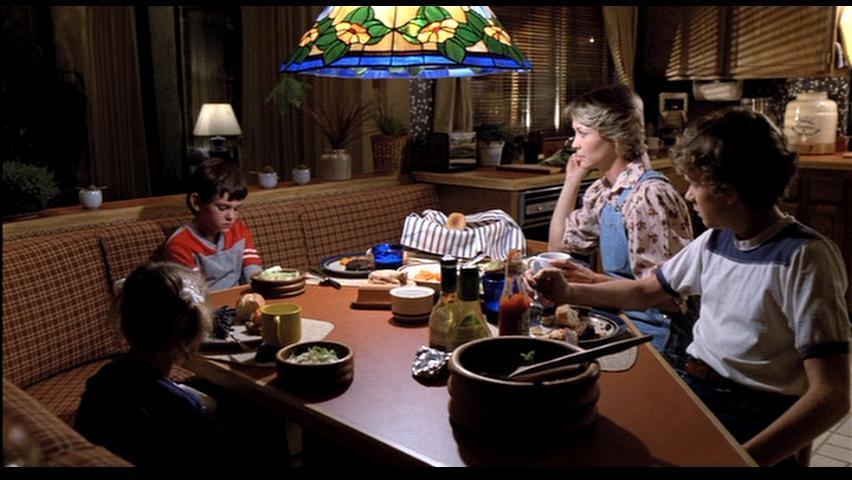
This young boy, Elliot (Henry Thomas), recruits his older brother Michael (Robert MacNaughton) and younger sister Gertie (Drew Barrymore) to keep their alien friend a secret from their mother, Mary (Dee Wallacec). The family resides in California, living dysfunctionally after Mary recently separated from the children's father who is physically absent during the film. Often, the adults in this film (excluding Mary) are faceless, we never see Elliot's teacher, father or any of the authorities (until the end of the film). The entire film is meant to focus on the little alien called E.T. and the three young children who befriend it.

Considering Elliot is 10, Gertie is 5 and Michael is 15 in the film, it is easy to assume that the children who performed these roles were near the same age. Even if they were slightly older than their characters, their performances were impressive to say the least. This is crucial for the film as it seems to revolve around childhood innocence. Since Elliot especially has an important role in the story, it is important that he seems genuine and kind while still being a believable child with flaws such as selfishness. This comes across nearly perfectly in Henry Thomas' performance, "He doesn't come across as an over-coached professional kid, he's natural, defiant, easily touched, cunning, brave and childlike," (Ebert, 2002).

It's effortless to see the resemblance between E.T. and Close Encounters as similar themes and characters run through the films. "In countless ways - its suburban setting, the similarities between Elliot and Roy Neary, the encroaching presence of the secret state, aliens - E.T. is a piece with Close Encounters," (Harris, 2000). Both take place in America, focusing on the relatable every-day life of an average family living in the suburbs. Just like Close Encounters, this draws the viewer in and makes them feel like the same events could happen to them.

Elliot and Roy both have dysfunctional families,  they're both trying to cope with struggles that many people face, such as the aftermath of divorce. However, they are both randomly 'chosen' and are thrown into a crazy, surreal adventure involving beings from outer space.  It is clear that Spielberg has a soft spot for family and often expresses it in his films, however in E.T. it feels much more sentimental. This could be because in Close Encounters the main character leaves his family to continue his adventure in (Spielberg later admitted he felt this was a mistake).

Fig. 2 Family Dinner.
Another similarity between Close Encounters and E.T. is that government/authorities are the bad guys, but in E.T. they seem to be more clueless than intentionally bad. It is unclear what actually causes the little alien to become sick and start to die. Elliot constantly screams that the scientists were killing him but this seems unlikely as E.T. is seen becoming ill before the authorities seized them. Michael even mentioned that the creature wasn't looking so good as they were finding materials to build a communication device. While it was clear in Close Encounters that some authorities were intentionally abusing their power over others, in E.T. it seems more subjective to Elliot's point of view. Admittedly, they were running tests on E.T. but they also attempted to revive him when he was dying. While the adults in E.T. may have been causing more harm then good and ignored Elliot's pleas, it would be wrong to say that they were pure evil. Spielberg does not spare us from the truth, in reality if there was an alien in the possession of the government, it would most likely be experimented on.

That truthfulness is another aspect that is admirable about Spielberg's films that involve aliens visiting our planet. He makes it seem as though it could happen in real life. Not only do the characters feel authentic in their ordinary lives, but the reactions of the characters and the government to the events that unfold feel as though they would happen in real life. It is likely that if a creature from another planet was in the possession of the government, tests and experiments would be conducted on it to learn more about it. If an alien was discovered on our planet, people would feel awe and amazement. However, it is highly likely people would also feel fear due to the unknown, even if it presents not threat to us.

E.T. like Close Encounters shows the very real reaction people would have to these situations. However, in both films Spielberg chooses not to include intergalactic warfare and death. Instead, he chooses to show that not everything that is strange or different is bad. "With E.T. - and his Close Encounters of the Third Kind - Spielberg redefined popular sci-fi. Extra-terrestrials no longer had to be a laser-blazing threat to humanity: the universe, he was saying, is also full of awe and wonder," (Lee, 2010).

Fig. 3 E.T.'s Ship

Bibliography:
Canby, V. (1982) E T The Extra Terrestrial (1982) At: http://www.nytimes.com/movie/review?res=9C0DEFDB143BF932A25755C0A964948260 Accessed on: 1/3/2016
Ebert, R. (2002) E.T. The Extra-Terrestrial At: http://www.rogerebert.com/reviews/et-the-extra-terrestrial-2002 Accessed on: 3/1/2016
Harris, J. (2000) Empire Essay: E.T. the Extra-Terrestrial Review At: http://www.empireonline.com/movies/empire-essay-et-extra-terrestrial-2/review/ Accessed on: 1/3/2016
Lee, M. (2014) E.T. the Extra-Terrestrial, review: 'redefined popular sci-fi' At: http://www.telegraph.co.uk/culture/11310774/Must-have-movie-ET-The-Extra-Terrestrial-1982.html Accessed on: 1/3/2016

Illustration List:
Figure 1. E.T. the Extra-Terrestrial [Poster] At: http://centerforcreativemedia.com/wp-content/uploads/2015/11/E.T..jpg Accessed on: 1/3/2016
Figure 2. Family Dinner [Film Still] At: http://images2.fanpop.com/images/photos/5000000/E-T-The-Extra-Terrestrial-et-the-extra-terrestrial-5075634-852-480.jpg Accessed on: 1/3/2016
Figure 3. E.T.'s Ship [Film Still] At: http://images2.fanpop.com/images/photos/5000000/E-T-The-Extra-Terrestrial-et-the-extra-terrestrial-5079717-852-480.jpg Accessed on: 1/3/2016

Saturday, 20 February 2016

Cutting Edge: Close Encounters Of The Third Kind

Often science fiction films that focus on an alien species visiting our planet for the first time results in death, destruction, and violence. However, with Steven Spielberg's 'Close Encounters of the Third Kind' (1977) this is definitely not the case. This enchanting film introduces Roy Neary (Richard Dreyfuss) as our hero despite his completely ordinary life. Even though the film was released in 1977, it's easy to say that the special effects have not become dated despite the drastic development in CGI since its release. The ending still feels captivating and magical, the giant surreal U.F.O. orchestrates a charming musical light-show for the scientists watching from below. The character's awe and amazement easily represents what the viewers feel while watching the climax of 'Close Encounters'.
Fig. 1 'Close Encounters of the Third Kind' (1977)

Despite the film being extraordinary and magical, when watching the film for the first time it is difficult to get a grasp on the alien's motives. "We've all become pretty used to what movies with aliens will entail...if 'Close Encounters' doesn't resort to explosions...then why is it such an exciting science fiction movie? 'Close Encounters' is saturated with imagery that fascinates, terrifies, and utterly consumes the viewer," (Haflidason, 2001). It's easy to fall into a state of anxiety and suspense while watching the film for the first time, assuming that the U.F.O's and aliens are up to no good. However, it is later discovered that this feeling of fear was unneeded and that the aliens never meant us any harm after all.

The question is, however, was Spielberg trying to make us feel afraid of these aliens despite how harmless they really were. It is difficult to determine, especially after the rather frightening scene of three year old Barry (Cary Guffey) get ripped out of his mother's arms by the red threatening lights that represented the aliens. In addition to Barry's abduction, the eerie score that accompanies scenes involving U.F.O's, the often horrified expressions of the characters, and the initial deep tonality of the mothership implies menace. Perhaps this was meant to immerse the viewers into the story since if aliens ever do visit Earth it will the a scary experience even if they are peaceful.

Fig. 2 Barry is abducted.

The story is even more immersive because of the characters presented to us. They are all very relatable because they are so average. Jillian Guiler (Melinda Dillon) is a single mother while the protagonist, Roy, is a simple electrical lineman. "He's an Average Joe working stiff with an exhausting family in a chaotic home smack in the middle of middle America. As such, a mass audience identified with him much more intensely than with a more conventional romantic adventure hero," (Errigo, 2000). Since Roy's character is so relatable to most people, his adventure is automatically more enchanting and exciting for the audience to witness. If these sorts of events can happen to Jillian and Roy then it could happen to anyone, even the viewer.  

Some argue middle section of the film contains much unneeded, tedious content that doesn't contribute to the story. However, seeing Roy's obsession with the U.F.O.'s and the vision implanted develop is possibly part of what makes the climax of the film so satisfying and dazzling. It also explains the significance of the tune that the scientists use to communicate to the aliens, which results in the supernatural musical performance at the end of the film that induces goosebumps. "The final thirty to forty minutes of the film, however, are what it's all about - and they are breathtaking...this sequence, as beautiful as anything I've seen since 2001, as been deliberately designed to suggest a religious experience of the first kind... This is the day the earth might have stood still," (Canby, 1977). 

Fig. 3 Contact

The contact with the mothership is what the viewer has been waiting for the entire film, and Spielberg doesn't fail to deliver. The scientists are awestruck as they watch the alien ship communicate with them via elegant colourful lights and a delightful melody. The score, created by John Williams, was constructed in a way that fits perfectly with the mood of the scene. While this music didn't become as iconic as the 'Jaws' theme, once you hear it, it is impossible to forget. It is refreshing to see a film that doesn't immediately identify something foreign as a threat. Spielberg created a film that proves that something different can be beautiful and doesn't automatically mean it is a threat.

Bibliography:
Canby, V. (1977) Close Encounters of the Third Kind (1977) At: http://www.nytimes.com/movie/review?res=EE05E7DF1739E560BC4F52DFB767838C669EDE Accessed on 19/02/2016
Errigo, A. (2000) Close Encounters of the Third Kind Review At: http://www.empireonline.com/movies/close-encounters-third-kind/review/ Accessed on: 19/02/2016
Haflidason, A. (2001) Close Encounters of the Third Kind (1977) At: http://www.bbc.co.uk/films/2001/06/26/close_encounters_third_kind_1977_review.shtml Accessed on: 19/02/2016
Murphy, A. (1977) Review: 'Close Encounters of the Third Kind' At: http://variety.com/1977/film/reviews/close-encounters-of-the-third-kind-1200424081/ Accessed on: 19/02/2016

Illustration List:
Figure 1. Close Encounters Of The Third Kind [Poster] At: http://www.postersfromhell.com/wp-content/uploads/2014/03/Close-Encounters-of-the-Third-Kind-Movie-Poster-Style-B-11x17-Inch-Mini-Poster.jpg Accessed on: 19/02/2016
Figure 2. Barry is abducted. [Film Still] At: http://screenmusings.org/movie/blu-ray/Close-Encounters-of-the-Third-Kind/pages/Close-Encounters-of-the-Third-Kind-130.htm Accessed on: 19/02/2016
Figure 3. Contact [Film Still] At: http://screenmusings.org/movie/blu-ray/Close-Encounters-of-the-Third-Kind/pages/Close-Encounters-of-the-Third-Kind-323.htm Accessed on: 19/02/2016

Tuesday, 9 February 2016

Cutting Edge: Jaws

Even though Stephen Spielberg's blockbuster hit, 'Jaws' (1975) is just over 40 years old, there is no doubt that it still celebrated and enjoyed today. Despite its now dated effects, after watching 'Jaws' it is difficult to go swimming without imagining a monstrous creature stalking you from below, especially if you feel something brush across your leg. This feeling of fear is contributed to Spielberg's ability to present simple, likable characters quickly along with limiting the amount of time the shark actually has on screen. The audience is left to create their own mental picture of the shark as it terrorizes its victims.

Fig. 1 'Jaws' (1975)
'Jaws' was notoriously difficult to film for Spielberg. It ran over budget, the mechanical sharks rarely worked properly, the crew had to film and manage equipment on the temperamental ocean waves, and the actual filming process took longer than expected. Despite all of this, 'Jaws' made a massive impact on its audience and on the overall way the film industry worked. "It was a complete nightmare that invented the 'summer blockbuster', launched the genius on a global scale and delivered an astonishingly effective thriller built on a very primal level: fear. Somehow it all fell into place," (Thomas, 2012).

One of the many reasons why this film was such a success is because of how it plays with the feeling of fear, something that every human being can relate to. It is difficult to imagine that someone wouldn't be horrified if an abnormally large shark with black dead eyes was circling them from beneath. Spielberg uses very few shots of the actual shark, most of it is implied through the use of P.O.V. shots, objects (such as the yellow barrels), or the iconic score that symbolizes the creature.

Fig. 2 The Yellow Barrels
Similarly to the score that accompanies the shower scene in Alfred Hitchcock's 'Psycho' (1960), the theme for the shark in 'Jaws' became instantly recognizable. "If ever there was an important example for how music can enhance a film, it is 'Jaws'. John Williams' memorable score is used sparingly but its tone of impending terror is more responsible for the power of the film than the sightings of the beast itself," (Haflidason, 2001). Even people who haven't seen the films can easily identify it.

However, if Spielberg failed to present us with likable, relatable characters then 'Jaws' may have been a very different type of film. Instead of feeling fearing for Brody (Roy Scheider), Quint (Robert Shaw), and Hooper's (Richard Dreyfuss) lives, we might be inclined to root for the shark to succeed at ruining Amity's tourist business. However, we care for the characters as we know Brody is attempting to save lives by closing the beaches while the selfish mayor, Larry Vaughn (Murray Hamilton) is more interested in making money. Of course, once the shark affects Larry's own family he tries to think of ways to convince himself he was doing 'what he thought was best'. He then finally agrees to hire Quint to kill the shark with the help of Brody and Hooper.

Both Quint and Hooper are also very charming characters in their own ways. Hooper is an intelligent young man with a genuine interest in marine biology and ends up doing all he can to warn the mayor and the citizens of Amity the dangers the shark presents. It is as frustrating for the audience as it is for Hooper when all of his warnings and expert advice go ignored. Hooper also seems to desperately try to get respect from Quint, a harsh, experienced shark hunter. Quint is a very stern and serious character but also has a more humorous side which can be seen as he sings drunkenly and compares scars with Hooper.

Fig. 3 Scars
Excluding Quint's monologue about his past (and his reason for hating sharks) we don't know much about their backstories. The characters are very simple, their history didn't need to be expanded on much for the audience to comprehend their role within the story. They are very recognizable archetypes, making them more understandable to a larger range of people. This is why they are so successful within the film, it doesn't take much time to make the audience recognize who the characters are and what they are meant to represent. While Spielberg could easily choose to elaborate and create more complex characters, he chooses not to.

This appears to be a recurring theme with this film. Both the story and its characters are simple but there is obviously much more beneath the surface. "There are no doubt supposed to be all sorts of levels of meanings... but Spielberg wisely decides not to underline any of them. This is an action film content to stay entirely within the perimeters of its story, and none of the characters have to wade through speeches expounding on the significance of it all. Spielberg is very good, though, at presenting those characters in a way that makes them individuals," (Ebert, 1975). 

To this day people continue to contemplate the real 'meaning' behind this film, for example some may say that the shark represents misogyny and violence towards women while others debate it represents the fear men have regarding castration. Some may see it as a film about how sometimes money and business is regarded more important than human lives. Either way, it feels very unlikely that there isn't some deep hidden meaning within 'Jaws', perhaps Spielberg even meant to have it symbolize multiple things. Whichever it may be, 'Jaws', despite its nightmarish filming process and cryptic meaning, managed to become the first summer blockbuster and remain a classic 40 years later.

Bibliography:
Chilton, M. (2015) Jaws, Review: 'Brilliant and Terrifying' At: http://www.telegraph.co.uk/film/jaws/review/ Accessed on: 9/2/2016
Ebert, R. (1975) Jaws At: http://www.rogerebert.com/reviews/jaws-1975 Accessed on: 9/2/2016
Haflidason, A. (2001) Jaws At: http://www.bbc.co.uk/films/2000/07/14/jaws_review.shtml Accessed on: 9/2/2016
Thomas, W. (2012) Jaws Review At: http://www.empireonline.com/movies/jaws/review/ Accessed on: 9/2/2016

Illustration List:
Figure 1. Jaws [Poster] At: http://static.comicvine.com/uploads/original/11/119238/3658491-2793285307-zbmry.jpg Accessed on: 9/2/2016
Figure 2. The Yellow Barrels [Film Still] At: http://movie-screencaps.com/jaws-1975/70/ Accessed on 9/2/2016
Figure 3. Scars [Film Still] At: http://movie-screencaps.com/jaws-1975/58/ Accessed on: 9/2/2016

Wednesday, 3 February 2016

Cutting Edge: Duel

When thinking of car chases in film, most people imagine sleek high-speed sports cars zooming down busy highways, skillfully evading other cars in their way. However, Steven Spielberg had very different take on a car chase in  'Duel' (1971). In Duel, Spielberg manages to piece together an engaging film with barely any plot or dialogue through camera placement and characterization of the truck.
Fig. 1 'Duel' (1971)
The truck, not the truck driver, is the antagonist in this film. The quarrel starts innocently as David Mann (Dennis Weaver) passes by a truck that is driving slowly on a desert highway. From there, the truck seems to slowly evolve into a monstrous creature, taunting David as it attempts to kill him. Other than David passing the truck on the highway there is no obvious reason for this attack, "Spielberg, to his credit, never affords the truck any rational motivation - the relentless pursuit takes on its own logic where societal rules quickly become superfluous," (Thomas, 2000).

In truth, this lack of explanation can feel rather frustrating but in time it is silently accepted. We begin to understand that the truck is a mindless being of its own, without any logic behind its actions. In a way, this heightens the audience's ability to feel the sense of danger. There is no explanation for this truck to come after him, and there is no way to escape or reason with it. This feeling of desperation is also partly due to the fact that we never actually see the driver, again there is no one to reason with.

Fig 2. The Truck
While the images of the truck and car feel repetitious at times, there are certain shots that certainly stand out. Camera angles looming low beneath the truck as it barrels towards David's car makes it feel like a great enraged beast. The composition these shots give off a, "cat and mouse theme, pepping up the pursuit with bizarro camera angles (big close ups of Mann captured with a telephoto lens) and sound effects (the truck's heavy duty rumble, the car's pathetic engine whine) all knitted together into stunning editing patterns," (Freer, 2000). Through composition of camera shots and the addition of these intimidating sounds, it is easy to feel David is being preyed upon.

However, David's character is barely developed in the story. In fact, this film doesn't really develop any of the human characters, "the vehicles are the real stars of 'Duel', and whenever the chase is interrupted by the relatively primitive people on hand...the film loses its momentum and becomes somewhat clumsy," (Maslin, 1983). We don't have much of an attachment to these human characters, often their interactions feel odd and uncomfortable. Luckily, these scenes of socially awkward situations and unpleasant, unflattering close ups of David do not last long.
Fig. 3 David Mann
Excluding a few scenes that include little chunks of dialogue and hints from the car's radio, we barely know anything about who David is, what is is doing and where he is going. The film does not have a complex plot by any means, but many speculate it is all about the main character's fight for his masculinity. Conversations on the radio, a few words exchanged with a gas station attendant, and an argument over the phone with his wife confirm his troubles at home and with himself.

This, again, is never explained to the audience. It can only be assumed that David feels a renewed sense of self after we see the monstrous truck descends into a ditch, a scene that is beautifully captured in slow motion. While we expect to either see the driver after this point or have some sort of closer, we don't. Instead, Spielberg ends it abruptly to leave the audience guessing. After his absurd and harrowing experience, David Mann sits himself down in the desert on the cliff the truck fell into and credits roll.

Bibliography:
Freer, I. (2000) Empire Essay: Duel At: http://www.empireonline.com/movies/empire-essay-duel/review/ Accessed on: 3/2/2016
Maslin, J. (1983) Duel (1971) At: http://www.nytimes.com/movie/review?res=9804EFD81138F936A25757C0A965948260 Accessed on: 3/2/2016
Thomas, W. (2000) Duel Review At: http://www.empireonline.com/movies/duel/review/ Accessed on: 3/2/2016

Illustration List:
Figure 1. Duel [Poster] At: http://images.moviepostershop.com/duel-movie-poster-1971-1020376106.jpg Accessed on: 3/2/2016
Figure 2. The Truck [Film Still] At: https://www.blogger.com/blogger.g?blogID=3956602142824296449#editor/target=post;postID=231674251756683574 Accessed on: 3/2/2016
Figure 3. David Mann [Film Still] At: https://quixotando.files.wordpress.com/2008/09/dennis-weaver.jpg?w=1024 Accessed on: 3/2/2016

Tuesday, 26 January 2016

Cutting Edge: The Birds

Alfred Hitchcock seems to always try to present the audience with a new and unusual experience. From 'Rope' (1948) where he used one single continuous shot for the duration of the film, to his most well known work, 'Psycho' (1960), with a metamorphic genre and violence the public has not seen before in cinema, it is clear he enjoys pushing boundaries. Alfred Hitchcock continued this trend with 'The Birds' (1963), a film that makes the viewer interpret the emotions and thoughts of the characters along with meaning behind the plot.

Fig. 1 'The Birds' (1963)
Similar to 'Psycho', 'The Birds' seems to swap between several different genres including comedy, romance, and horror/monster. Somehow, Hitchcock manages to make this work alongside the bizarre 'attack of the birds' story. While the film starts off slow, we are presented with an array of characters all of which aren't particularly likable. However, as time passes and strange bird attacks commence it is easy to still be interested in the characters and wonder what will happen even if we don't like them. We want to see what happens to them while it also becomes clear that the story is not really about evil, aggressive birds at all.

While the effects are not particularly frightening (a seagull pecking at someones hand does not look very scary), the camera shots and sound design is what makes this film unsettling. While the sound of the birds when they attack remains familiar there is something eerily different about it, it falls within the Uncanny Valley. The sound makes them feel unnatural, or maybe supernatural, as if they have been possessed by an evil spirit or infected by some sort of disease.

While there is no actual score within the film, Bernard Herrman (who designed the famous score used in 'Psycho') developed the other-worldly sounds of the birds during their assaults. Using the absence of music within the film, Hitchcock is able to build up an impressive amount of tension before chaotic bird attacks, "...the bird-attack sequences are tremendously complex...and the absence of a score renders the horror more immediate: Hitchcock's long-time composer Bernard Herrmann fashioned an eerie soundtrack of claws, strident with screeches and rustling wings," (Sooke, 2015).

Fig. 2 Bird Horde
Another tool that Hitchcock uses to build up unease is the interactions between the characters as expressed through different camera shots. It is apparent that Hitchcock is skillful with manipulating the camera to get across a character's thoughts and emotions without any dialogue, and in this case, without any score. For example, this film seems to focus very much on the stereotypical (and sexist) female psyche. This includes being overemotional, overprotective, sensitive, and jealousy towards other women.

Just by how Hitchcock frames his characters, it is clear to see how one is jealous or feel threatened by the presence of another. For example, it is clear that Annie (Suzanne Pleshette) was a previous lover of Mitch's (Rod Taylor) and is jealous of Melanie's (Tippi Hedren) relationship with him. Just by how the two interact and how the camera moves from one to the other, we can see that they feel threatened by each other but aren't exactly rivals either. Another example is Mitch's overprotective mother, Lydia (Jessica Tandy). Due to how Hitchcock placed his cameras and sequenced his shots, a simple glance from Lydia towards Melanie is all it takes to express her feelings of jealousy and vulnerability.

Fig. 3 Jealous Mother
It is debated that these feelings of jealousy, anger, and tension is the 'cause' of the birds actually attacking. The film never provides a direct explanation, but one popular belief is that the birds attack due to the emotions of the women. However, it is not "...made readily clear whether Hitchcock meant the birds to represent the classical Furies that were supposed to pursue the wicked on this earth...the context of the birds concentrating their fury upon a house in which a possessive and jealous mother hovers anxiously over her son is so obvious and fascinating that I rather lean to it," (Crowther, 1963). Hitchcock leaving this part of his story open for interpretation is both frustrating and exciting as it allows the viewer to come up with their own explanations and theories.

The reason behind the birds attacking is not the only thing that Hitchcock left open-ended. Unlike 'Psycho', this film has no clear outcome or ending. In fact, Hitchcock seems to tease the audience by having Mitch hear a radio report near the end of the film saying that there have been bird attacks in other cities. This does not mean the ending was a let down, "what stirs me the most about The Birds is not what it puts in but what it leaves out...Electrifying, insurrectionist Psycho still felt the need to wheel on a psychiatrist to explain Norman Bates...But The Birds floats free...a non-resolution, an open ending - the perfect closing that leaves the world in the balance and its mysteries all intact," (Brooks, 2012). Instead of forcing a strict conclusion, sometimes it is better to end on a high note to allow the viewer to question and reflect.

Bibliography:
Brooks, X. (2012) My Favourite Hitchcock: The Birds At: http://www.theguardian.com/film/filmblog/2012/jul/31/my-favourite-hitchcock-the-birds Accessed on: 26/1/2016
Crowther, B. (1963) The Birds (1963) At: http://www.nytimes.com/movie/review?res=9D05E7D9143CEF3BBC4953DFB2668388679EDE Accessed on: 26/1/2016
Sooke, A. (2015) The Birds, Review: 'Disturbing' At: http://www.telegraph.co.uk/culture/film/filmreviews/11334674/The-Birds-review-disturbing.html Accessed on: 26/1/2016

Illustration List:
Figure 1. The Birds [Poster] At: http://www.clevelandcinemas.com/images/promos/birds.jpg Accessed on: 27/1/2016
Figure 2. Bird Horde [Film Still] At: http://the.hitchcock.zone/wiki/1000_Frames_of_The_Birds_(1963)_-_frame_950 Accessed on: 26/1/2016
Figure 3. Jealous Mother [Film Still] At: http://the.hitchcock.zone/wiki/1000_Frames_of_The_Birds_(1963)_-_frame_283 Accessed on: 26/1/2016

Tuesday, 19 January 2016

Cutting Edge: Psycho

Alfred Hitchcock's 'Psycho' (1960) is a film that everyone knows about in one way or another, even if they haven't seen the film itself. From the infamous murder scene in the shower to the signature piece of music that accompanies it, 'Psycho' has become embedded in cinema history. The low-budget film featured bold scenes that, at the time of its release, were gruesome and shocking to the audience. Nothing like it had been presented to the public like that before, but the way Hitchcock executed it made the film work. In fact, it worked so well that it spawned an entirely new subgenre for horror films - the slasher.

Fig. 1 'Psycho' (1960)
Now audiences are accustomed to violently gory scenes, or even go to see films specifically to witness blood, guts and murderous psychopaths. However, 'Psycho' would probably disappoint fans of slasher films if they were solely interested in brutality and gore. 'Psycho' doesn't show the knife actually puncturing flesh and the amount of blood is very minimal compared to the violence featured in films such as 'The Texas Chainsaw Massacre' or 'Friday the 13th'. Society at the time wasn't ready violence that graphic. The film was purposely shot in black and white to mellow down the murder scene, preventing the audience from the vibrant red colour of blood. However, unlike the typical modern fast-paced slasher films, Hitchcock takes his time to get to the killing.

Instead, he draws it out, "...that's the way it is with Mr. Hitchcock's picture- slow buildups to sudden shocks that are old-fashioned melodramatics, however effective and sure, until a couple of people have been gruesomely punctured and the mystery of the haunted house has been revealed," (Crowther, 1960). Hitchcock makes us feel comfortable believing that this is a story about a young woman, Marion Crane (Janet Leigh) who steals $40,000 to help out her lover. However, midway through the film Hitchcock throws us a curveball by killing off our protagonist...or at least we thought she was our protagonist.

Disturbingly, however, it is easily to suddenly feel as though Norman Bates (Anthony Perkins) is the new hero. Although it is relatively obvious Norman is the murderer, it is almost instinctive to side with the young man as he appears shocked at the discovery of Marion's corpse, "Hitchcock is insidiously substituting protagonists. Marion is dead, but now (not consciously but in a deeper place) we identify with normal--not because we could stab someone, but because, if we did, we would be consumed by fear and guilt, as is he," (Ebert, 1998).

Norman hurriedly clears up the murder scene, giving the impression he has experience disposing of dead bodies. He even knows a location in a swamp to dispose of Marion's body along with her car and belongings. Despite coming to the conclusion Norman has killed before, we still feel the pressure when the car hesitates while sinking... along with the relief when it disappears into the muck. The pressure returns as Norman is later interrogated by a private investigator searching for Marion. This feeling of guilt and stress is played on by Hitchock's use of camera shots. He focuses in on Norman's throat from curious angle, signaling vulnerability to the investigator. In turn, the investigator's prying eyes are captured using close-ups of his face for the duration of the scene to increase the sense that he is dominating the situation.

Fig. 2 Norman's Throat
Another example of this is when Marion is stopped by a policeman on the road, his face fills the entirety of the shot as he gazes at Marion as she nervously searches through her purse. It is easy to see that he is intimidating and she is terrified despite the fact that he is oblivious to the situation she is in. Hitchcock uses the various methods to control his audience throughout the film, "Hitchcock's mischievous genius for audience manipulation is everywhere: in the nourish angularity of the cinematography, in the use of Bernard Herrmann's stabbing string score, in the ornithological imagery that creates a bizarre sense of preying and being preyed upon," (Monahan, 2015).

The use of music and editing is part of what made 'Psycho' a classic. The notorious shower scene uses over 70 pieces of film which have been cut and edited together using montage editing to create an experience instead of just a passive moving image the audience witnesses. By adding score created by Bernard Herrman on top of this montage, Hitchcock managed to put the viewer in the position of Marion as she was being stabbed to death by a mysterious figure. That sequence itself became arguably one of the most recognizable and celebrated scenes/movie score in cinema history.

Near the end of the film, Hitchcock presents us with one more morbid twist. Norman Bates has a split personality with a childish, obedient Norman being one and his abusive, controlling mother being the other. Technically, according to the psychologist in the film, it was Norman's mother who was a killer. Watching the film now, the scene where the psychologist explains Norman's mental state to us seems tedious but it gives us a look into how mental illness was viewed in the 1960's. Not many people knew anything about it and even went out of their way to ignore it

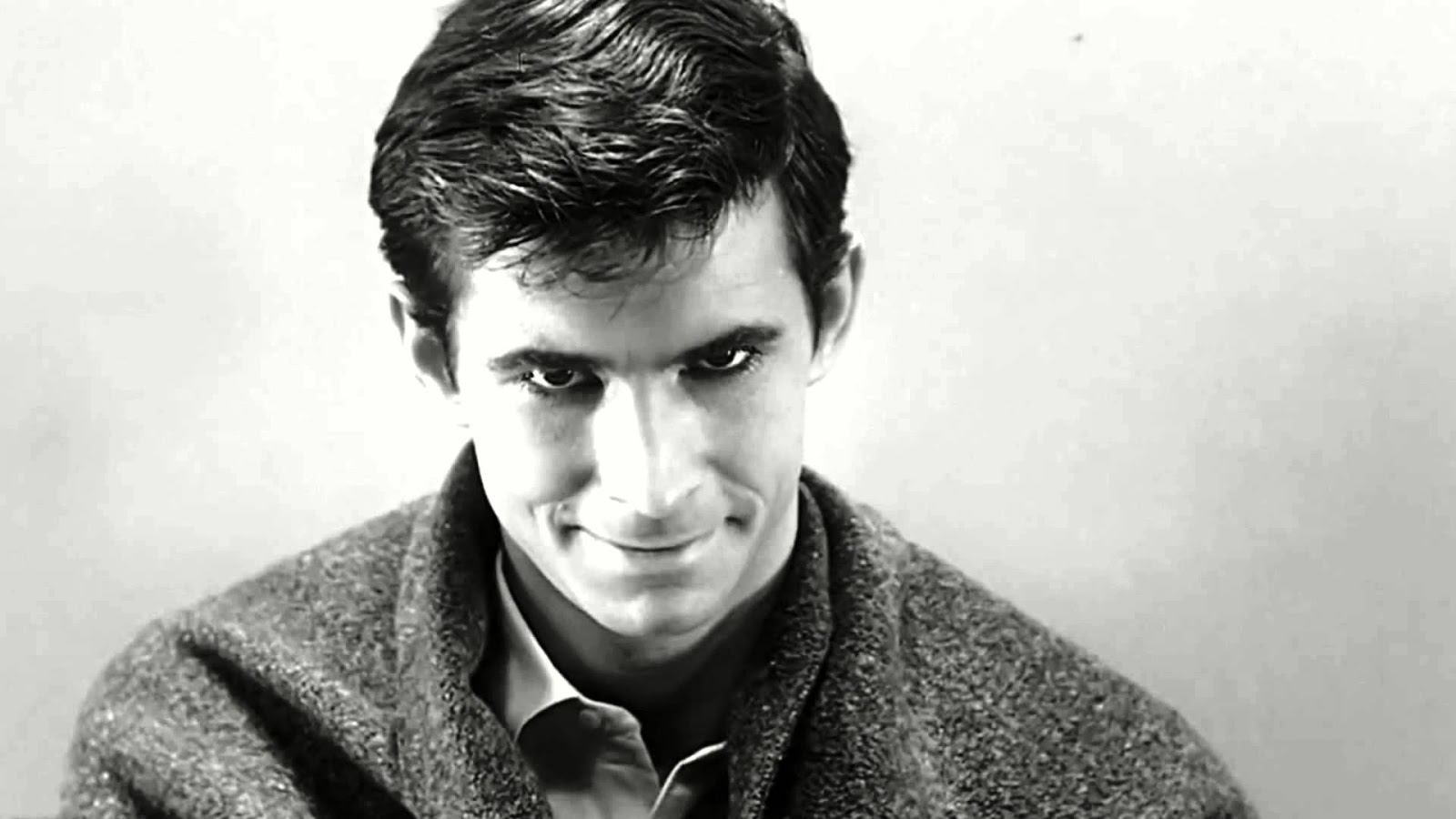
Fig. 3 Norman/Norma Bates
The film ends with Norman (or Norma) smirking at the audience, who now know the full truth behind Norman's disturbing behavior. It's almost as if Hitchcock himself is sitting in that chair, smiling at the viewer. He manipulated the perspective and feelings of the audience while getting away with exhibiting murder and violence in a way that has never been seen before.

Bibliography:
Crowther, B (1960) Movie Review Psycho At: http://www.nytimes.com/movie/review?res=EE05E7DF173DE273BC4F52DFB066838B679EDE Accessed on: 19/1/2016
Ebert, R. (1998) Psycho At: http://www.rogerebert.com/reviews/great-movie-psycho-1960 Accessed on: 19/1/2016
Monahan, M. (2015) Psycho, review At: http://www.telegraph.co.uk/culture/film/filmreviews/11025424/Psycho-review.html Accessed on: 19/1/2016

Illustration List:
Figure 1. Psycho [Poster] At: https://img1.etsystatic.com/002/1/5927693/il_fullxfull.359974463_rlia.jpg Accessed on: 19/1/2016
Figure 2. Norman's Throat [Film Still] At: http://the.hitchcock.zone/wiki/1000_Frames_of_Psycho_(1960)_-_frame_604 Accessed on: 19/1/2016
Figure 3. Norman/Norma Bates [Film Still] At: https://i.ytimg.com/vi/nceYiqf0CPw/maxresdefault.jpg Accessed on: 19/1/2016

Tuesday, 12 January 2016

Cutting Edge: Rope

It is easy to conceive a false impression of a film without even seeing it, especially when it is surrounded by mixed reviews and ratings. Alfred Hitchcock's experimental film 'Rope' (1948) is one that should be watched with an open mind and unaltered opinion despite what critics say. At the time of it's release, it was often considered a failure due to Hitchcock's attempt at making a continuous shot film, this one consisting of a 'single' 80 minute scene. In reality, he had to split it into 10 minute segments and attempted invisibly morph the pieces together to give the illusion of a single continuous shot. This interesting and different take on editing, or in this case lack of editing, is perhaps what 'Rope' is best known for.

Fig. 1 'Rope' (1948)
It is argued that this attempt at having a single continuous shot is the film's ultimate downfall. However with films today using longer shots and scenes, it isn't as easily noticeable as it probably was during the film's original release. Admittedly, Hitchcock could have achieved a film with the same atmosphere even using numerous shots, cuts and editing. Using a single continuous shot was "...an unnecessary gimmick. Although when a director cuts from one shot to another it can seem as if time has passed, that is not necessarily the case. Many films that deal with uninterrupted spans of time use a lot of cuts..." (Ebert, 1948).

However, Hitchcock was experimenting and wanted to do something different. It is unlikely he was unaware of his ability to use shots without actually passing time within the story. Of course, filming one continuous shot had its drawbacks. The camera Hitchcock had to use was large and provided challenges in terms of mobility as the set was an unchanging apartment, so it wasn't particularly spacious. While this presented obstacles with filming, the cramped, confined feeling is part of what heightened the tension in 'Rope'. This tension is particularly felt in scenes when a number of conversing characters are crammed (sometimes very awkwardly) into one shot, "This clunkiness can be part of the film's claustrophobic strength though: the coffin-chest is rarely out of shot, and the camera follows the actors around every square inch of the confined set. They're trapped, and so is the audience," (Hutchinson, 2012).

Crowded Conversation
While this continuous shot technique was experimental and disliked by many, it is difficult to label 'Rope' as a failure. While there are sections of the film that are dull, such as when the dialogue seems to be several groups of people just making small-talk, the camera itself in no way takes away from the story. The continuous shot, although noticeable at times, is not usually overly distracting and does not inhibit the story-telling, "It is true that the questing Hitchcock camera is not inflexible...he has followed the goings and the comings of the characters with evident ingenuity. His camera stands back and takes them in, singles them out on occasion and even moves in now and then for close looks," (Crowther, 1948). Hitchcock is still able to create intense and revealing close-ups of the characters while also achieving wider shots of the whole apartment... starting from the living room, crossing the hallway, into the dining room and finally through the door into the kitchen.

Fig. 3 The Apartment
While it is rather predictable how the plot of 'Rope' will play out, it is still an engaging story. It is nice to see that well known and successful directors like Alfred Hitchcock try out experimental and innovative techniques to create something different, even if it's not entirely successful. It is a shame that at the time of its release, 'Rope' wasn't appreciated more for its creative ingenuity and uniqueness, especially considering the amount work it was for everyone involved in the film to keep the process orientated. Hopefully considering how much filmmaking has evolved since the release of 'Rope', more people can appreciate how Hitchcock was willing to risk failure to test a new, inventive filming technique.

Bibliography:
Crowther, B. (1948) Movie Review Rope (1948)  At: http://www.nytimes.com/movie/review?res=980DE3D81630E03BBC4F51DFBE668383659EDE Accessed on: 12/1/2016
Ebert, R. (1984) Rope At: http://www.rogerebert.com/reviews/rope-1948 Accessed on: 12/1/2016
Hutchinson, P. (2012) My Favourite Hitchcock: Rope At: http://www.theguardian.com/film/filmblog/2012/jul/27/my-favourite-hitchcock-rope Accessed on: 12/1/2016

Illustration List:
Figure 1. Rope [Poster] At: https://filmbalaya.files.wordpress.com/2010/12/tm1_642.jpg Accessed on: 12/1/2016
Figure 2. Crowded Conversation [Film Still] At: http://creofire.com/wp-content/uploads/2013/10/Rope2.jpg Accessed on: 12/1/2016
Figure 3. The Apartment [Film Still] At: https://blogger.googleusercontent.com/img/b/R29vZ2xl/AVvXsEglGruCgf-9QcXVsw1l4H6C5e9OmPf7ESWtw7aiyFv3dAIDX0bEpbBC7jQcPbmFJzDEFO3LL02LloiekPTgmy3KyDl7EwhigoniRxL_1BNF8puvECDVHGoM57F5MmpGZbTKg86m_DPiziZf/s400/rope9.jpg Accessed on: 12/1/2016

Tuesday, 5 January 2016

Cutting Edge: La Jetée

The first time viewing Chris Marker's French science fiction short 'La Jetée' (1962) is a truly unique experience. With how technology has impacted current cinema, not only is it strange to watch a film in black and white, but see one consisting only of still images (in black and white) is almost otherworldly. However, this does not negatively impact the 30 minute photomontage in the slightest. Alternatively, it gives the film an almost nostalgic feel to it, the narrator's voice over the still images makes the film feel as though it's a bedtime story being told by ones father or grandfather.

Fig. 1 'La Jetée' (1962)

The still black and white images paired with the haunting music and narration causes the viewers to quickly attach to the characters and become part of this surreal world, "...it's an astounding example of what you can do as a filmmaker once you have a great story...The impact is far stronger compared to other films that have everything but such a powerful idea behind it," (Samuel, 2013). Despite the use of only still images Chris Marker doesn't allow the film to appear choppy or  jumpy in any way, instead he waltzes us from one photo to another. Each image is smoothly transitioned to the next, sometimes only minute changes appear such as eyes opening or closing or the turn of a head. These transitions make the film feel like a dream, which is perhaps how the main character would feel like while traveling through time.

The story itself, although obviously a sci-fi, has an unusual romantic twist to it. Even in such a strange situation, the protagonist and the woman he seeks seem to be bound by an invisible bond that is unexplainable yet imperishable. The images Chris Marker uses for the sequences focusing on the protagonist's relationship with the woman are both sorrowful and intimate. Their love seems so pure and innocent in the ill-fated world that surrounds them. The score accompanying the images adds to this effect, "La Jetée's lead actors are beautifully doomed, as is Trevor Duncan's score; and the resonant measured narration (from Jean Negroni) is poetic and fluorescent, infused with awe and mystery..." (Sellars, 2005). Everything feels calm and peaceful yet uneasy and confusing as it's not clear if it's real, just a dream or some sort of alternate reality.


Despite this appealing love story, there is a much more sinister and selfish motive behind the scientists sending the man back to his past. After the scientists conclude that the protagonist can handle a trip to the future instead of the past, they send him to ask for power and resources. The individuals that greet him in the future send him back with a source power so people in the present can start rebuilding. They also offer to take the protagonist into the future for good to escape the execution that awaits him as he has completed his task and has no further use. However, the man requests to be sent to his past to be with the woman he loves. It is here we discover that time is ultimately an unbreakable loop.

When he returns to his past, he is shot dead in front of the woman and a crowd of people including a child who is actually the protagonist himself as a kid. This ending leads to a multitude of deep questions such as can we really change time or is it written for us already, can time really be changed or is it a loop. Regarding the story, this moment is heartbreaking for the viewer. Not only did the protagonist finally become free to spend his life with the woman, but it's now recognizable how futile his efforts to be with her were from the start, "...it is one of the most tender and true portrayals of love that I have ever come across...love is a cocoon against tyranny, but it is too fragile to survive. In the end, darkness wins." (Pilger, 2014).

Fig. 3 Protagonist Being Shot

La Jetée is without a doubt a piece of art, it presents multiple philosophical ideas/questions, it throws the viewer into an engaging science fiction/love story, exhibits beautiful black and white photography, a delicate score, and a strong narration. These elements were expertly pieced together to create a one-of-a-kind science fiction film that has inspired multiple other films including Terry Gilliam's '12 Monkeys' (1995). It is difficult to think of another film that presented imagery and art in a way such as La Jetée, let alone one that did so successfully. It is a shame that films today tend to not adopt such experimental and abstract methods, it is often forgotten that filmmaking is also a form of art.

Bibliography:
Pilger, Z. (2014) Chris Marker: Mystic Film-Maker With a Midas Touch At: http://www.independent.co.uk/arts-entertainment/films/features/chris-marker-mystic-film-maker-with-a-midas-touch-9273471.html Accessed on: 5/1/2016
Samuel, P. (2013) La Jetée At: http://staticmass.net/world/la-jetee-1962-review/ Access on: 5/1/2016
Sellars, S. (2005) Retrospecto: La Jetée At: http://www.ballardian.com/la-jetee Accessed on: 5/1/2016

Illustration List:
Figure 1. La Jetée [Poster] At: http://st.kp.yandex.net/images/film_big/160900.jpg Accessed on: 5/1/2016
Figure 2. The Woman [Film Still] At: http://bloodmountain.org/wp-content/uploads/2013/06/la-jetee-242279l.jpg Accessed on: 5/1/2016
Figure 3. Protagonist Being Shot [Film Still] At: http://4.bp.blogspot.com/-iw9GzcmzJxE/UCKL6ZuqcUI/AAAAAAAAF_s/8vXKVmru3Rw/s1600/jetty4.png Accessed on: 5/1/2016