

Showing posts with label Research. Show all posts
Showing posts with label Research. Show all posts
Wednesday, 31 January 2018

Monday, 29 January 2018


Saturday, 6 January 2018


Saturday, 30 December 2017
Minor Project: Material Influence Map #2
As I wanted to work a bit on some bone materials, I had a look at some reference. I looked a lot at the internal structure of human bone, especially bones that were afflicted with Osteoporosis. I did this because those who suffer from Anorexia are often diagnosed with Osteopenia or Osteoporosis due to the lack of nutrients, causing bone density to decrease.

Wednesday, 27 December 2017
Minor Project: Word Maps #2
Here are some more word maps relating to the words in my poem. There are a few that I skipped, but if I feel I need to I'll return to them (or any of these).


Minor Project: Word Maps #1
I decided it would be useful to look over my script and try to deconstruct some of the words I chose to use in my poem. The phrases I wrote in my poem came from instinct, but as I try to create my film it may be useful to have a look at what some of the words mean so I am not too literal with their interpretations. Here are some of the words from the first four stanzas of my poem, I plan on going through the rest of my poem to deconstruct some more words later today. I think this exercise will help me consider what I feel and what emotions I want to portray while creating my textures and lighting the objects.


Friday, 15 December 2017
Minor Project: Material Influence Maps #1
Now that I'm planning on moving onto some other textures/materials, I thought it would be a good idea to share some influence maps showing some images that I looked at while creating my ice and sponge textures. Since I'm trying to achieve relatively realistic results, I know that looking at reference is very important (for some materials I may go out and find reference myself so I can look at them more in person). These textures may still require some tweaking as time goes on, but I also want to move onto textures such as chicken skin.
For the snow/ice texture, I decided to go with ice because it reminded me of the frozen lake in front of my grandparent's house. I may see if I can add some snow details onto it or perhaps find some special effects to give it a sort of dry ice fog/mist effect. For the sponge I looked both at sea sponges and synthetic sponges and I may still experiment with some other colours. I have begun looking at both chicken skin and human skin for reference, I'm pretty sure I'm going to go for a raw chicken skin rather than a cooked one as raw meat - especially poultry - is repulsive to me and I'm often nervous about handling.


For the snow/ice texture, I decided to go with ice because it reminded me of the frozen lake in front of my grandparent's house. I may see if I can add some snow details onto it or perhaps find some special effects to give it a sort of dry ice fog/mist effect. For the sponge I looked both at sea sponges and synthetic sponges and I may still experiment with some other colours. I have begun looking at both chicken skin and human skin for reference, I'm pretty sure I'm going to go for a raw chicken skin rather than a cooked one as raw meat - especially poultry - is repulsive to me and I'm often nervous about handling.


Thursday, 7 December 2017
Minor Project: Initial Label Designs #1
To further evoke a sense of 'hospitalisation' or some sort of institution, I was encouraged to explore ways of labelling my texturing experiments that will later on help me design my Art Of document. After some conversations, it became clear that it would be a good idea to explore the font and layout of medical prescriptions, pill packets/drug information tables, and nutritional information. It's odd because before I started actually looking at references, I didn't realise how similar medication labels and nutrition labels were which I think is interesting considering what my project is about.

I also researched a little online about which fonts are best for nutrition information and medication/drug information. Both of them recommend clear, easy to read fonts such as Arial, Helvetica, Franklin Gothic, and Verdana. I also found on this website that recommends using APHont as it is apparently easier to see for those who have weaker vision (I saw several other websites mention this font as well). I explored these fonts in the tests below, which were inspired by 'Drug Facts' (specifically the 'Active ingredients' section). I think out of all these fonts I prefer Helvetica, Arial, and APHont but I think I want to explore a few other fonts too. Some fonts were wider so for this test, some of the 'Bump Value' sections were shortened to 'Bump Val'...I'd change this in the final version but for this test I wanted everything to be the same dimensions. The render time in this is also made up for now.

I think this will be really interesting when paired with my texture tests. I need to figure out what backdrop/ground I want when rendering these images as well so I can keep it consistent throughout all the textures. I also plan to explore a few other layouts for these labels...for example, maybe including some bullet points or having it be more similar to a food label instead.
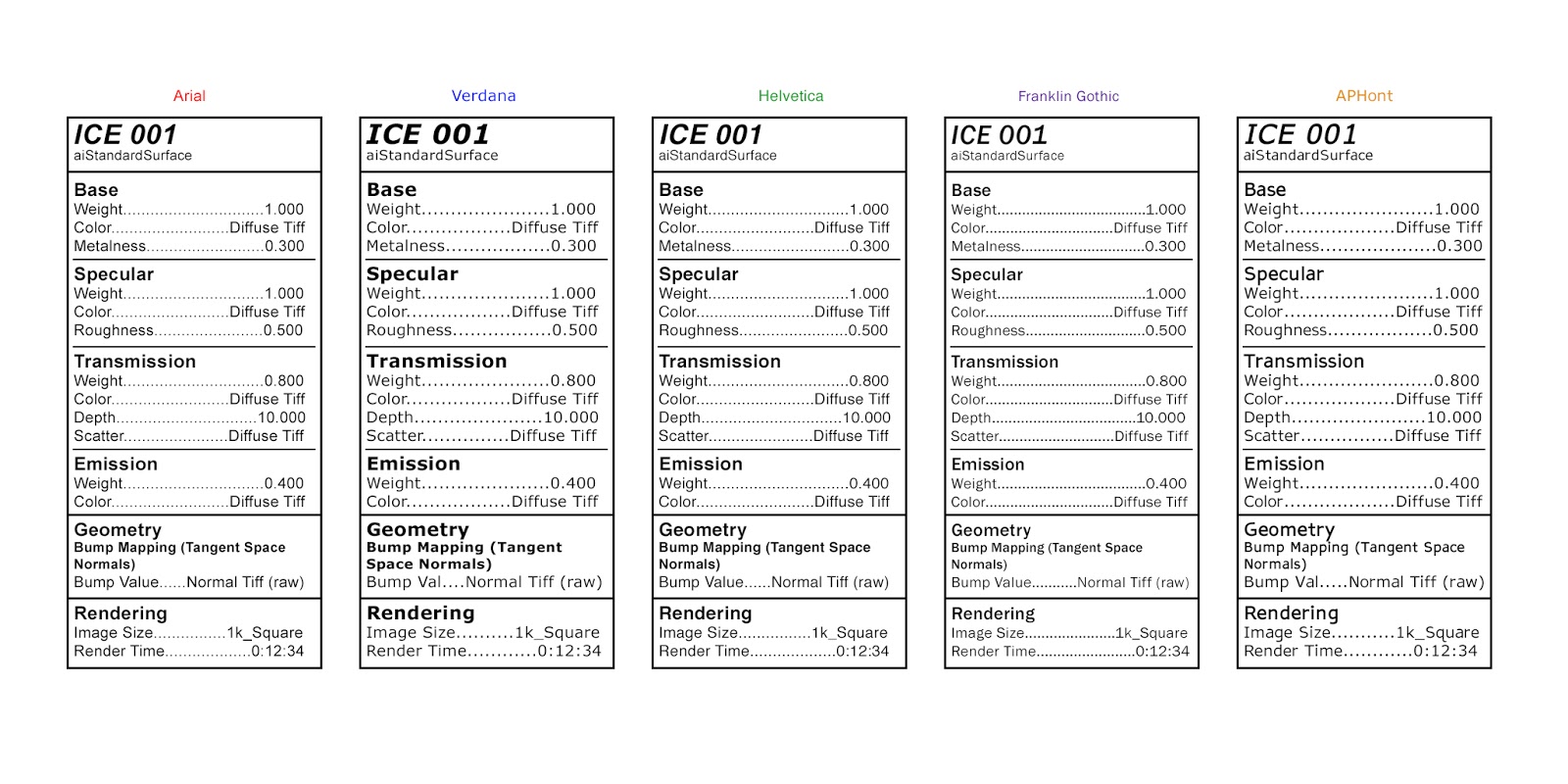
I also researched a little online about which fonts are best for nutrition information and medication/drug information. Both of them recommend clear, easy to read fonts such as Arial, Helvetica, Franklin Gothic, and Verdana. I also found on this website that recommends using APHont as it is apparently easier to see for those who have weaker vision (I saw several other websites mention this font as well). I explored these fonts in the tests below, which were inspired by 'Drug Facts' (specifically the 'Active ingredients' section). I think out of all these fonts I prefer Helvetica, Arial, and APHont but I think I want to explore a few other fonts too. Some fonts were wider so for this test, some of the 'Bump Value' sections were shortened to 'Bump Val'...I'd change this in the final version but for this test I wanted everything to be the same dimensions. The render time in this is also made up for now.

I think this will be really interesting when paired with my texture tests. I need to figure out what backdrop/ground I want when rendering these images as well so I can keep it consistent throughout all the textures. I also plan to explore a few other layouts for these labels...for example, maybe including some bullet points or having it be more similar to a food label instead.
Tuesday, 5 December 2017
Minor Project: Projection Reflection/Refraction Test #1
One of the experiments on my list was to test out how a projection may behave when projected through several layers of geometry or through several 'screens' or 'walls'. To do this, I created a wave using a polygon plane extruded on a cure I created in the side view. I then mixed together a combination of different presents on the aiStandardSurface material including clear water, deep water, glass, and frosted glass. I then added a gobo filter with my footage onto the spot light and adjusted the rays in the render settings to try and ensure the light would pass through all of the layers.

It was difficult to see the results at first, and I tried my best to render out something that was interesting (apologies if the quality seems low, since this is just a test I didn't want it to take too long to render and I also time stretched the footage so it would go slower). I think this has potential, but at the moment I found it somewhat difficult to control. But I do think the use of transparent or semi-transparent objects or reflections may be interesting in combination with some of the previous tests I have done. I think this sort of thing needs further experimentation and research before I decide if it's something useful or not.


It was difficult to see the results at first, and I tried my best to render out something that was interesting (apologies if the quality seems low, since this is just a test I didn't want it to take too long to render and I also time stretched the footage so it would go slower). I think this has potential, but at the moment I found it somewhat difficult to control. But I do think the use of transparent or semi-transparent objects or reflections may be interesting in combination with some of the previous tests I have done. I think this sort of thing needs further experimentation and research before I decide if it's something useful or not.

Sunday, 3 December 2017
Minor Project: Voiceover Influences & Script Adjsutment
Over the last week I've been working to get some initial takes of my voiceover. Doing my own voice acting is something that I admit I've been terrified to try out - any sort of acting, even voice acting, is way beyond my comfort zone. However, since this project is so personal and it feels so important to me I am doing my best to work past that and make a decent voiceover. Once the sound booth at UCA was up and running after some technical issues, I spent a few hours over the course of two days to get as many initial take as I could. For the first clips I kept it relatively simple so I had a base and to ensure that I had the ability to do it and that it should indeed be me doing it in the first place. Over the next few weeks I'm going to work on adding more expressiveness to my voiceover...I hope as I practice and do it more I'll get better. I did find that the second day I recorded I did better and felt more comfortable so I hope that continues.

While I'm not including any of the voiceover clips in this post (maybe I'll include some once I have a final version), as I spoke the words I thing I had a better idea of what I wanted my poem and animation to be like. I decided to scrap the line "When I think of my family I feel dread" as I feel that this line in combination with the other lines, was unbalanced and leaned towards a more negative feeling towards my family. This is not what I wanted as I more so wanted to express a sort of 'guilty' or 'split' feeling in regards of my family.

I also spent some time looking at some spoken word/poetry readings in hope that it'll help me get more expressive in my recordings. Here are some I found powerful...Neil Hilborn has always been one of my favourite poets to listen to.
Tuesday, 28 November 2017
Minor Project: Lighting 2 - Rendering with Arnold
After some experimentation in Arnold yesterday, I felt it would be good for me to go back over the Lighting & Rendering tutorials as they have been updated for the Arnold renderer. I'm more accustomed to Mental Ray at the minute versus Arnold so I hoped focusing in on those tutorials will help me become more familiar with how the render settings and lights have changed so I can better understand what I'm doing.
I have not looked at the stylized tutorials too much since in my projection I'm looking more at realism but I may at least watch them just in case there are any other useful tips in them. I still want to go over the HDR Dome, Sky Dome, Standard Surface, and Geometry Override Sets tutorials as well as any other relevant tutorials that pop up over the next few weeks.


I do feel I now have a better understanding of how the lights work in Arnold which is good since yesterday I felt pretty clumsy with them and it took longer for me to get close to what I wanted to achieve due to my unfamiliarity with this version of Maya. I do wonder, however, if yesterday my light was bugged as I set the penumbra angle and drop off correctly (and was visible in the viewport) but still appeared as if nothing changed. Today it seemed to work fine, so that's good at least and I'm confident I'll get the hang of it as I practice more.
Wednesday, 18 October 2017
Minor Project: Influences & Related Imagery
Between working on YPGTTO, I've been trying to look at imagery so I can hopefully get a better idea of what I'd like my animation to possibly be. Some of these videos include some films and artists that I find interesting. I've come across work by Murat Pak that I found to be very interesting. I liked how simplistic, 'clean', and realistic yet slightly unsettling these animations are.
Resonance: "Recreation" from Pak on Vimeo.
Some of the films I found most interesting was a series called 'The Node' - each version has the same footage but different audio/music artists responded to it. Some of my favourites include Reality Eight, Reality Seven, and Reality Three. I think that this is an interesting approach to this film because each film has a very different feel and that is all dependent on the sound. I enjoyed Reality Eight because of the spoken words, I enjoyed the music in Reality Seven, but I felt the most emotional impact from the sound in Reality Three.
I've also tried looking at some other videos that is just stock footage/imagery related to my phrase list. I'm hoping to use these images to eventually put together a sort of pre-vis for my animation. I've been looking at some images and videos of things such as pufferfish, spines, autumn leaves, slugs, sugar and so on. I wonder if it may be interesting to incorporate some live action footage into my animation in some way...but for the CGI elements I do think it would be a good idea to keep it simplistic and clean so it is hopefully more impactful
Wednesday, 27 September 2017
Minor Project: Edited Phrase List #1, Ideas & Brainstorming
After more discussions, I have a somewhat solidified list. I still need to narrow things down...I'm trying to remove things that I don't feel are as impactful or phrases that I feel are somewhat repetitive/do not offer much more than other phrases already have. I'm finding this quite difficult since all of them have emotional weight for me so it's hard to pick the 'less important' ones but I'm also trying to consider what may or may not work in terms of visuals and transitions as well. These are just my initial thoughts on the list and obviously they may still change and develop.

I'm also trying to look at some more animations and tutorials in hopes I can try to get a more concrete idea of what I want my film to be and/or some techniques that may be helpful. At the moment I'm looking into the possibility of using blend shapes to morph an object into a range of different shapes but I'm not quite sure if that'd be the best. I also wonder if perhaps animating bump/displacement maps may be an interesting thing to explore.

I'm also trying to look at some more animations and tutorials in hopes I can try to get a more concrete idea of what I want my film to be and/or some techniques that may be helpful. At the moment I'm looking into the possibility of using blend shapes to morph an object into a range of different shapes but I'm not quite sure if that'd be the best. I also wonder if perhaps animating bump/displacement maps may be an interesting thing to explore.
Thursday, 21 September 2017
Minor Project: 'When' - Initial Ideas, Creative Writing Exercises, and Phrase Lists
Admittedly I've so far kept my Minor Project ideas behind closed doors, but I now feel ready to begin sharing my thoughts and ideas on this project (which I temporarily labelled as 'When' - this obviously may change). Dysmorphia was a very personal piece of work for me - and it helped me discover how to use Maya as an art medium rather than a mechanical piece of software.
I really enjoy working with Maya, After Effects and other programs, and the topic of Mental Illness/ internal conflict is something I still feel I need to explore and discuss. This is why for my Minor Project I want to create a piece of work that is even more raw and honest in hopes it may help people understand that everyone experiences the world differently.
To get started on this, I've been given a list of questions/prompts to answer as honestly as I can. Some were direct, some more abstract, and some intended to be more directly triggering. Some examples include "Tell me about a favourite childhood memory", "Why is Halloween important to you?", "Imagine your illness is/was architecture; describe its structure, its materiality, its exterior and interior spaces, its location, its functions etc", "What makes you laugh?", "What makes you cry?", and several others.
However, it was agreed that the prompts that led to the most interesting result were:
"You need to try and make someone else understand your relationship to food and to eating - but you have to use similes in order to do so - find the images that express the truth of your feelings.
You need to try and make someone understand your relationship to your own appearance - but you have to use similes in order to do so - find the images that express the truth of your feelings."
To answer these questions, I answered with long lists that I tried my best to write honestly and quickly without thinking (essentially I tried 'free association' writing). I felt myself that this was the most direct and honest response since I tried my best to not give myself time to second guess my answers and responses.

From here, I was given several other phrases to answer in a similar way regarding my feelings/thoughts towards other people's bodies, my relationship with my family, my idea of perfection, my relationship with hospitals, my relationship with happiness, what (in my view) it feels/means to be Anorexic, and what hope is to me. I have several long lists in response to this, and I am currently in to narrow down the lists and select the ones that are the most truthful, have interesting contradictions, and may be interesting visually.
From my understanding/what I imagine, I will aim to create realistic, morphing textures on some sort of object or abstract form to represent these phrases to achieve an emotional reaction from my audience (both positive and negative) to express the a constant internal conflict. I think my phrases will create a sort of poem that will be voiced over the animation (and I would like to collaborate with a music composer in conjunction with my own sound design if possible/appropriate).
While I'm not quite sure what this will be just yet, I have a few films and animations that I feel may relate to what I feel this may be or that I just find interesting.
 |
| Dysmorphia (film still) |
I really enjoy working with Maya, After Effects and other programs, and the topic of Mental Illness/ internal conflict is something I still feel I need to explore and discuss. This is why for my Minor Project I want to create a piece of work that is even more raw and honest in hopes it may help people understand that everyone experiences the world differently.
To get started on this, I've been given a list of questions/prompts to answer as honestly as I can. Some were direct, some more abstract, and some intended to be more directly triggering. Some examples include "Tell me about a favourite childhood memory", "Why is Halloween important to you?", "Imagine your illness is/was architecture; describe its structure, its materiality, its exterior and interior spaces, its location, its functions etc", "What makes you laugh?", "What makes you cry?", and several others.
However, it was agreed that the prompts that led to the most interesting result were:
"You need to try and make someone else understand your relationship to food and to eating - but you have to use similes in order to do so - find the images that express the truth of your feelings.
You need to try and make someone understand your relationship to your own appearance - but you have to use similes in order to do so - find the images that express the truth of your feelings."
To answer these questions, I answered with long lists that I tried my best to write honestly and quickly without thinking (essentially I tried 'free association' writing). I felt myself that this was the most direct and honest response since I tried my best to not give myself time to second guess my answers and responses.

From here, I was given several other phrases to answer in a similar way regarding my feelings/thoughts towards other people's bodies, my relationship with my family, my idea of perfection, my relationship with hospitals, my relationship with happiness, what (in my view) it feels/means to be Anorexic, and what hope is to me. I have several long lists in response to this, and I am currently in to narrow down the lists and select the ones that are the most truthful, have interesting contradictions, and may be interesting visually.
From my understanding/what I imagine, I will aim to create realistic, morphing textures on some sort of object or abstract form to represent these phrases to achieve an emotional reaction from my audience (both positive and negative) to express the a constant internal conflict. I think my phrases will create a sort of poem that will be voiced over the animation (and I would like to collaborate with a music composer in conjunction with my own sound design if possible/appropriate).
While I'm not quite sure what this will be just yet, I have a few films and animations that I feel may relate to what I feel this may be or that I just find interesting.
Thursday, 9 March 2017
Adaptation B: Influence Map #4
Since it's been a while since I made an influence map and my idea has changed quite a bit, I thought it'd be a good idea to make a new one. I took the suggestion of looking at instillation art to see how objects become uncanny when they are in large groups such as Antony Gormley's Field, a large mass made of little terracotta sculptures. I also looked at the Terracotta Army, Alberto Giacometti, Choi Xooang, Marcy Milks, Cai Guo-Qiang and a few other pieces and artists I thought may be relevant.
I plan on working more on my randomly animated figures soon and I've also tried to think of a possible title for my project. Someone suggested naming it something like 'Body_Test#' since I have been using that system to name my tests in Maya files. It also can represent the detachment from the human body that some people may have with body dysmorphia and uses the sort of language used within Maya to label things so it feels somewhat automated if that makes sense. Once I have some more broken figures I may look into how I can randomly generate/place them in a scene and then see if I can figure out how I can make that scene for VR, even if it is just using Sketchfab for this test but I'd like to try and figure out how to use Unity (or attempt to).


Thursday, 23 February 2017
Adaptation B: Virtual Reality Options
Today I met with JJ, a tutor from the Canterbury campus who has experience with Unity and Virtual Reality. I found this very useful, and I've done my best to jot down notes about the different things we discussed. I was happy to learn that the majority of my pipeline would remain in Maya, which is obviously what I am more familiar with. However, I also learned that the remaining work that would need to be done in Unity would also most likely need to be done with the computer that is attached to all of the VR equipment or else I'd be bombarded with errors and be unable to work properly.
I've learned that for the Vive, I'd need to download the SteamVR Plug-in, would give me access to the asset store. This would help me with dropping in the right controllers/cameras instead of the default cameras to allow head movement (apologies if I get any of this wrong or if I word it poorly). It would also give me access to different scripts that would let events such as sound effects (which is important and needs to be created as 3D sound) be triggered based on where the viewer is looking. This is similar to how it would work with Cardboard as well only it would be the Google VR SDK for Unity instead (and I'm guessing if I made VR for Cardboard that would avoid the issue of needing the specific computer and kit all attached since it's not for the Vive headset).
Since further investigation is needed in regards to the VR equipment at the Rochester campus, it was also suggested that I perhaps simplify my idea down in terms of technology and try to make something for Google Cardboard rather than the Vive at least for tests. After this meeting I went and I downloaded the Sketchfab VR app on my iPhone and tested that out as well. Both animated 3D models and 3D environments are available on Sketchfab and I think it was useful for me to return to my Goji headset to look at this option rather than immediately diving into the Vive. Unfortunately, my iPhone is small (SE) so it wasn't as spectacular as it probably would have been using a larger phone.
I've tried to think of pro's and con's of both making a VR animation for the Vive and for Cardboard. I admit part of me is more drawn to the Vive because I feel it'd be more immersive and a higher quality experience. However, there may be issues with the equipment available to me at the moment and I'd need to plan on times to work on that specific computer. I also know that less people would have access to viewing my animation if it was made for the Vive rather than the Cardboard due to the cost and accessibility of the Vive in comparison to Cardboard. For Cardboard, I don't feel it'd be as immersive of an experience but would get the idea across. This is mostly because according to what I have read in VR UX and what I have heard in tutorials on Lynda.com, the field of view and resolution in the Cardboard is quite a bit less than the Vive (the Vive has more vertical screen space while the Cardboard is limited to widescreen).
Basically, despite the difficulties and perhaps having a smaller audience, I'd prefer to create something for the Vive since my project's topic is important to me and I'd like make it as immersive as possible. To me, having it made for the Vive would make it more impactful and higher quality, despite the added amount of difficulty.
However, I'm wondering if perhaps for this project I could test out the pipeline of using Maya then Unity to make a VR experience for Cardboard first...and perhaps as I bring it on for my third year I could alter that and use what I've learned to make it for the Vive if everything works. Apologies again if I said anything incorrect, I don't claim to completely understand the process but I'm trying my best to understand it better. Feel free to correct me.
I've learned that for the Vive, I'd need to download the SteamVR Plug-in, would give me access to the asset store. This would help me with dropping in the right controllers/cameras instead of the default cameras to allow head movement (apologies if I get any of this wrong or if I word it poorly). It would also give me access to different scripts that would let events such as sound effects (which is important and needs to be created as 3D sound) be triggered based on where the viewer is looking. This is similar to how it would work with Cardboard as well only it would be the Google VR SDK for Unity instead (and I'm guessing if I made VR for Cardboard that would avoid the issue of needing the specific computer and kit all attached since it's not for the Vive headset).
Since further investigation is needed in regards to the VR equipment at the Rochester campus, it was also suggested that I perhaps simplify my idea down in terms of technology and try to make something for Google Cardboard rather than the Vive at least for tests. After this meeting I went and I downloaded the Sketchfab VR app on my iPhone and tested that out as well. Both animated 3D models and 3D environments are available on Sketchfab and I think it was useful for me to return to my Goji headset to look at this option rather than immediately diving into the Vive. Unfortunately, my iPhone is small (SE) so it wasn't as spectacular as it probably would have been using a larger phone.
 |
| Sketchfab VR |
I've tried to think of pro's and con's of both making a VR animation for the Vive and for Cardboard. I admit part of me is more drawn to the Vive because I feel it'd be more immersive and a higher quality experience. However, there may be issues with the equipment available to me at the moment and I'd need to plan on times to work on that specific computer. I also know that less people would have access to viewing my animation if it was made for the Vive rather than the Cardboard due to the cost and accessibility of the Vive in comparison to Cardboard. For Cardboard, I don't feel it'd be as immersive of an experience but would get the idea across. This is mostly because according to what I have read in VR UX and what I have heard in tutorials on Lynda.com, the field of view and resolution in the Cardboard is quite a bit less than the Vive (the Vive has more vertical screen space while the Cardboard is limited to widescreen).
 |
| VR Headset Comparison |
Basically, despite the difficulties and perhaps having a smaller audience, I'd prefer to create something for the Vive since my project's topic is important to me and I'd like make it as immersive as possible. To me, having it made for the Vive would make it more impactful and higher quality, despite the added amount of difficulty.
However, I'm wondering if perhaps for this project I could test out the pipeline of using Maya then Unity to make a VR experience for Cardboard first...and perhaps as I bring it on for my third year I could alter that and use what I've learned to make it for the Vive if everything works. Apologies again if I said anything incorrect, I don't claim to completely understand the process but I'm trying my best to understand it better. Feel free to correct me.
Wednesday, 22 February 2017
Adaptation B: Idea Tweaks
After having a few discussions, I think I need to tweak my idea slightly. Firstly, I think I may focus more on body dysmorphia rather than overall 'mental illness' or anxiety. Part of this is because I feel that anorexia and body dysmorphia is seen a lot less in animation or video games in comparison to other mental illnesses. I find that its often unlikely that people understand anorexia/body dysmorphia in comparison to the others, so finding a way to express what it's like to others could be interesting.

In an attempt to describe body dysmorphia into words, I'm going to use one example but I know this differs from person to person. For one person, body dysmorphia could mean that person is unable to recognise themselves in a mirror...this could just be isolated to their body or it could include both their body and their face. For example, if someone with body dysmorphia was cloned or had an identical twin and had to pick that clone out of a group of other individuals, they may struggle to pick which one was the clone/twin. Someone with body dysmorphia may also find that their appearance constantly changes, and features that they notice one day may no longer be present the next day...for example, one day that person may think that their eyes are too far apart or are strangely shaped but the next day they may think the opposite. Another example is one day that person may think they are overweight but the next they do not, or they may think they are even more overweight than the other day (or throughout the day this changes) when in reality nothing has changed. Overall, the person's perception of their physical body is not reality and is not what other people see.
This is often difficult for people to understand unless they have experienced it before. This is similar to anorexia which, despite it having the highest mortality rate out of any other mental illness, is often respond with awkwardness and confusion. Often people frustratingly say "why don't you just eat" or "you don't look anorexic anymore" depending on the situation. The idea that a person does not feel hunger, ignores instincts to eat, or physically/mentally cannot get themselves to eat unless forced is bizarre to many people.
Both of these things are chemical imbalances in the brain, or sort of 'glitches'. And that leads me to a few ideas I had in regards to my project. Instead of going for the obvious representation of these feelings I have in my mind that are obviously grotesque mutated body forms, after getting feedback I think it may be more useful to simplify this down so more people can understand it instead of just being immediately disgusted or spooked. So using either a simple shape or later on using a model of the average human body, I'd want to experiment both in Maya and Mudbox and see different ways I could 'break' the model or morph it. For example, I could experiment with different automated processes in Maya such as rigging, skinning, or animation and see what it does to the model.
The reasoning behind this is because this automated processes are things that should just work, like how the human brain should be able to recognise its own body or how a living thing should just be able to eat...but people suffering with these mental illnesses struggle to do so. Basically, I want to try and use glitches and broken things in these software and see what it does to these forms and then I want to populate a space with these broken objects as a way to try and express these illnesses and feelings. I feel that the glitches and broken things I can use in Maya in itself could provide an uncanny experience/environment, even if it is not obviously so.
I think using some of the tools in Mudbox may be interesting to do this as well (I already sometimes do this when trying out new tools, only I undo it instead of working with the mistakes), or build upon things that I could make in Maya Obviously I am unsure exactly how to present these things at the moment, until I experiment more...but someone has already suggested possibly doing some sort of VR art gallery of these ever decaying, changing forms so that may be interesting. Perhaps finding other procedurally generated processes in Maya could produce interesting results as well. Overall, I want to take things that 'should just work' but are 'glitched', 'broken' or just wrong in some way and trying to present them in a way that compares them to how body dysmorphia and anorexia can affect some individuals.
Apologies for the long text post, but my previous posts were lacking in text and I've been struggling to articulate my ideas. I hope this is more on the right track, and I'm hoping my ability to put my ideas into more proper words is a positive sign. I'm also including a few videos that may not seem relevant but some I find interesting visually and I think may have interesting methods to explore (such as 2016 AICP Sponsor Reel by Method Studios). Some of the other videos I like the tone and may be something I may want to take influence from.
Tuesday, 14 February 2017
Adaptation B: Possible Project Outcome, VR Research & Unity
After my tutorial today I was able go to away and find some more information about Unity, which will probably be part of how I make my animation for VR. I'm not quite sure how to use Unity, but I'm hoping that if I go to visit the VR studio at the UCA Canterbury campus, I'll get some pointers. I'll also begin looking at Lynda.com for any videos along with any information on the Unity website about how to use it and how to create VR. Luckily, Unity is offered as 'Personal' for free, so I've already downloaded it. Depending on how all of this works may change the outcome of my project but I hope that I will be able to still continue with my idea of creating something in VR. At the moment, I think I hope to produce some storyboards suited for VR, environment/creature designs, tests in VR, and anything else I can accomplish during this time. I also plan on doing the Lighting & Rendering tutorials along with at the very least a portion of the Games Modelling tutorials, although this may change once I learn what I'd need to create something in VR. I found a few useful links and books in regards to VR creation, Unity, and storyboarding for VR.
 |
| https://unity3d.com/learn/tutorials/topics/virtual-reality |


Tuesday, 31 January 2017
Adaptation B: Readjusting Ideas
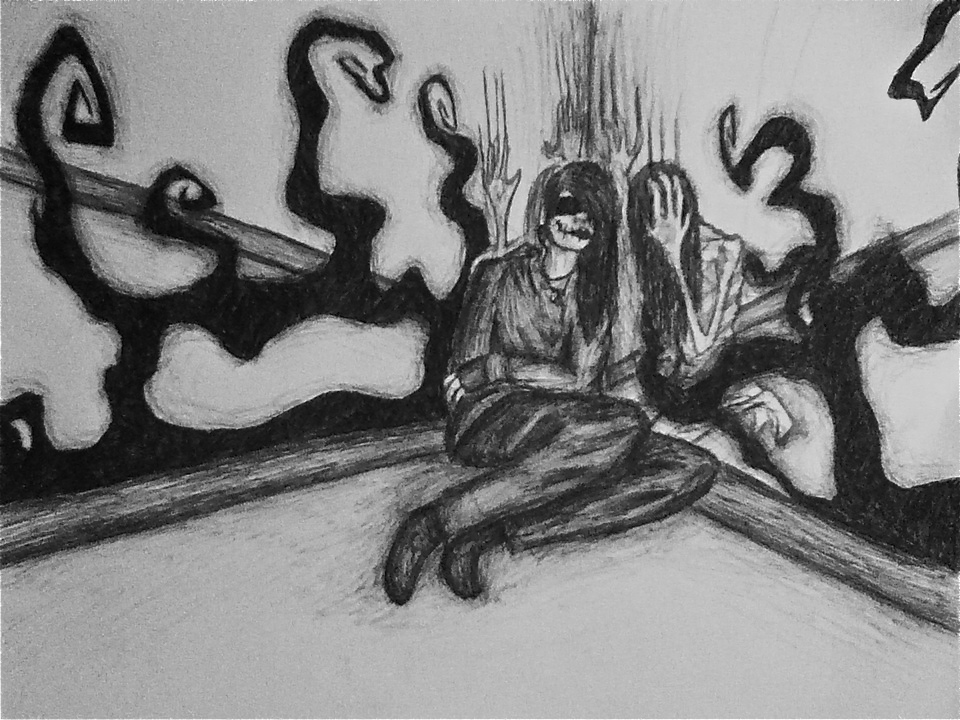
So after a few discussions today I feel like I have a better understanding of what direction to go in for this project. I was slightly confused over the last week but I've been directing most of my focus towards the infographic as that is due in sooner. However, now that I feel like I am on the right track with that, I feel like I'm on a better path with this project too. Basically, my new aim is to create a relatively 'plain' or normal space that slowly begins to become more cramped as these masses begin to appear. These masses will be inspired by my old artwork in relation to mental illness and how it makes an individual feel. I'm aiming to exploit the idea of the uncanny/the abject to give the viewers an uneasy feeling. I also, as I've said previously, feel that soundscape will be vital and I hope to make the objects within my space to also speak using content gathered from various people.
 |
| Note: By "not really about anything" I more so just meant that there does not need to have/should not have a specific definitive ending, leaving it open or looping may give more of an impact and keep people thinking. |

I've realised that now I'm not quite sure what I'm actually meant to have for this specific project as I also want to bring this into third year. However, I feel that the use of a combination of software including Maya, Mudbox, ZBrush, and programs such as Substance Painter will be useful to create something realistic but also uncanny. I'm not quite sure how I'd animate the objects, but I quite liked the jittery animation of Little Otik (and by 'like' I mean it makes me feel uneasy). I also like some of the things in Agony, a game that I shared in a previous post as I feel the use of fleshy design, teeth, and other unusually organic materials as environments is interesting.
Overall, I'm happier with my direction now than I was, even though I feel it is slightly more blurred between environment and creature design but I'm ok with that. I also feel that this idea will be enhanced by a VR experience through both the visuals and auditory experience, while before I was losing the need for VR as it didn't enhance anything. In this post I'll include a few videos of things I feel inspire me currently along with a few more selected artworks I've done, but more can be found here.


Subscribe to:
Posts (Atom)